Why is there no such thing as "The Best Chocolate Bar"

The New York Times recently published an article titled "The Only Chocolate Bars Worth Buying" by Mackenzie Oster, based on recommendations from 43 food professionals.
The panel included pastry chefs, bakers, restaurateurs, cookbook authors, café owners, ice cream makers, entrepreneurs, and two chocolate makers. I disagree with both the premise and the conclusion.
This is not because I believe the options included are necessarily poor choices. Some bars are made by chocolate makers I respect and have recommended myself. My disagreement begins with the certainty of the claim and the way the list presents chocolate as a fixed, standardized product with definitive answers, which is totally wrong!

After more than a decade professionally evaluating cacao beans and chocolate, I find it difficult to accept the idea that a handful of bars (or just a few brands) could represent the only chocolate bars worth buying in a fragmented market that includes hundreds of chocolate makers and thousands of options, many of which change from one harvest and batch to the next, or are produced in such small quantities that they never reach mainstream retail.
The panel is qualified to rank the wrong thing
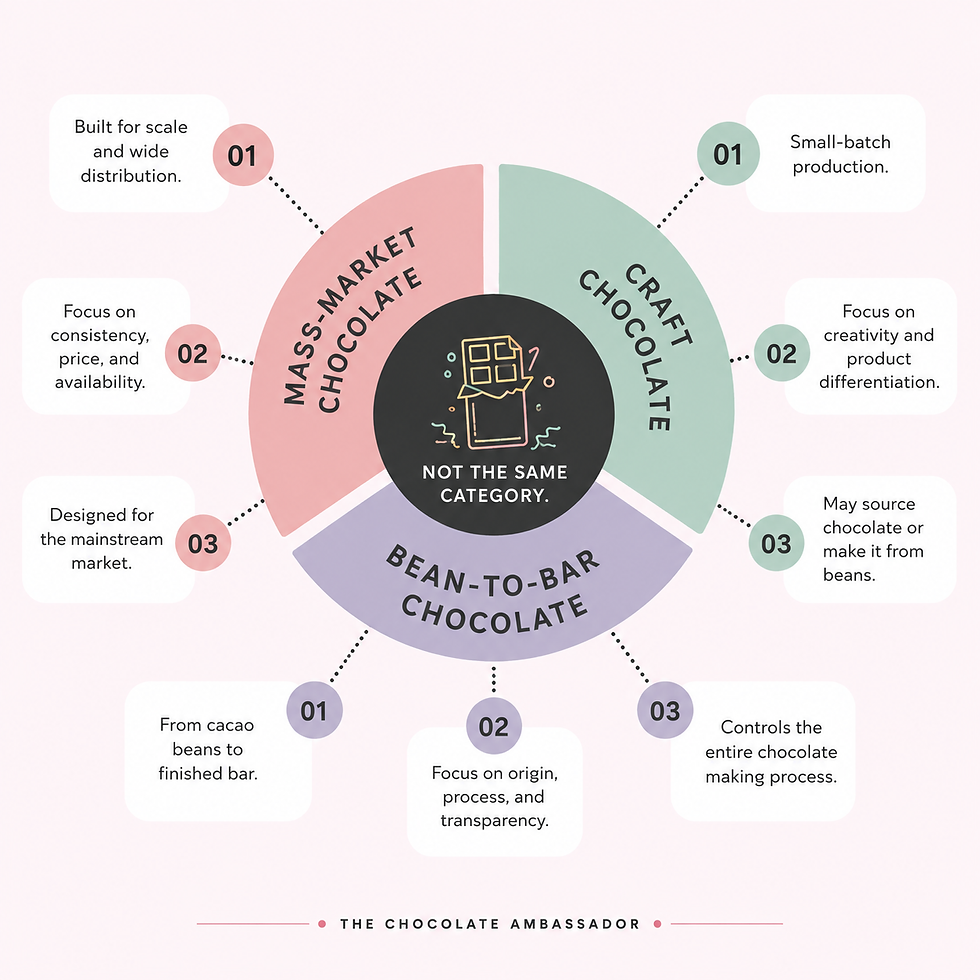
The first problem is what's being compared. Mass-market chocolate, craft chocolate, and bean-to-bar chocolate don't belong on the same chart. Tony's Chocolonely and Cadbury are not doing the same work as Dandelion, Soma, or Fruition. You can enjoy all of them. You cannot rank them against each other and call it "preference."
Either the 43 professionals have zero clue about the intricacy of the chocolate industry, or they place so little value on chocolate that everything is reduced to “what tastes better" in the most personal, commercial, and juvenile sense. In either case, the result signals a lack of appreciation for chocolate.
This is also, separately, a question of who's qualified to make the call.
Being a chef, food writer, or culinary professional doesn't automatically make someone an expert in chocolate. Yet, somehow, we hand chocolate's evaluation to anyone who's ever run a kitchen!?
One of the clearest examples is the widely viewed tasting in which Gordon Ramsay preferred MrBeast's candy bar over To'ak Master Series. Whether someone agrees with his preference is beside the point, but when a Michelin-star chef with his influence publicly compares a candy bar producer to one of the world's most ambitious tree-to-bar chocolate makers, he reinforces the idea that expensive chocolate is inherently ridiculous or pretentious.
It reflects a view of chocolate that begins and ends in the candy aisle, where price alone becomes the measure of value, and everything else (like craftsmanship and the effort to preserve Ecuador's Nacional cacao) is totally dismissed.
"We enjoyed these" and "these are the best chocolate bars" are different claims
The list represents the preferences of a very limited group of people, and there's nothing wrong with that. The problem is the panel — or the headline, or both — collapsing "here are some bars we like" into "these are the only ones worth buying."
Now, I understand why a chocolate maker would proudly share the article after being mentioned by The New York Times. Recognition by a major publication is flattering, and visibility matters.
But if I had spent years sourcing cacao, building direct relationships with farmers, refining my craft, and making chocolate in small batches, I would feel uncomfortable seeing my work placed in the same chart as large-scale mass-market producers.
It is not only a matter of being included. It is a matter of how you are being included!
If international chocolate awards suddenly rewarded products from Walmart's candy aisle alongside the world's finest chocolate, we wouldn't be so happy, would we? Yet when a media list places producers of all kinds side by side under the title “the only chocolate bars worth buying,” the same "confusion" is perceived as harmless. I do not think it is!
Lists like this shape what consumers believe quality looks like and whose work gets attention. Blending every category into a single ranking doesn't just misrepresent the market; it erases the very distinctions professionals and a masthead like this should help readers understand.
We can't claim to be educating consumers while celebrating articles that erase the distinctions we're trying to explain.
When “The Only Chocolate Worth Buying” actually makes sense
If the New York Times article had been framed as a guide to supermarket chocolate, the discussion would have been different: one recommendation remains equally valid regardless of who is buying it, when they are buying it, or what else is on the market.
Think about it: if you are standing in the candy aisle at Walmart, Aldi, or Whole Foods, the selection is limited. Many of the products are made by brands whose goal is consistency and quantity.
A Lindt bar purchased today should taste essentially the same a year from now. The same applies to Tony’s Chocolonely, Cadbury, and many other widely distributed brands. Their flavor profiles and recipes are standardized. Their business model is repeatability.
In that context, if someone asks me which chocolate bar is worth buying, I can confidently answer (recommending nothing!). The same is true for most organic grocery stores and large online marketplaces.
But the graphic doesn't only include Cadbury, Tony's, and their neighbors. Fruition, Dandelion, and Soma are on it, and two chocolate makers sat on the panel. That means someone at the table knew craft and bean-to-bar chocolate, which means we are not talking about a lack of knowledge. The panel conclusion reflects having it and flattening it anyway, into one ranked chart, under a headline claiming the discussion is settled. That's not the same failure as writing for a general audience. It's closer to knowing better and doing it anyway.

Historical significance gets confused with superiority, too. Valrhona Manjari is one of the most important Madagascar dark chocolates ever made, and its reputation is earned. But important isn't the same as currently the best available. If we're specifically talking single-origin Madagascar chocolate today, I can name far better alternatives with more complexity and a more memorable tasting experience than Manjari offers now.

Chocolate is not a standardized product
Once you enter what I prefer to call the specialty chocolate world, where chocolate makers work with single-origin cacao and small-batch production, the goal is no longer to reproduce the exact same flavor profile forever in large amounts, but to express what a particular cacao variety, from a particular place, at a particular moment, has to offer.
Take Dandelion, for example, mentioned as one of the best and most expensive in this clickbait list. They have produced many outstanding bars over the years. What I struggle to understand is why that specific bar should represent the best they have ever made, and why you should buy only that one.
Dandelion frequently adds new origins to their selection, allowing you to even compare the same dark chocolate made from the same cacao beans (same origin, variety, harvest) by two different chocolate makers, one based in California and one in Japan. Proving my point exactly, not all chocolate is one-dimensional and predictable. A recommendation that feels completely justified today may not taste the same two years later or be made by different people at the same moment. So what are we talking about here?

Furthermore, someone on their panel pointed out their favorite Fruition and Soma. Both are makers I genuinely enjoy. Despite their premium prices, they remain among the most approachable I know. Their lineup offers softer, rounder, and less challenging tasting experiences than those of many others like Dick Taylorx. That makes them excellent introductions for beginners moving beyond industrial chocolate without immediately encountering unconventional flavor profiles.
But again, why those particular bars?
Fruition produces a wide range of products. Reducing the entire selection to a single option inevitably overlooks many other offerings that someone else, myself included, might find more interesting. The same applies to Soma. I have enormous respect for what they do, but after years of tasting specialty chocolate from around the world, I no longer consider them among the best. That isn't a criticism. It reflects how much the fine chocolate landscape has grown over the last decade, including my definition of complexity.

The best chocolate for whom?
Every recommendation is shaped by context: who's tasting, what they've tasted before, what they can afford, what's actually available where they live.
I don't recommend chocolate to everyone the same way. Handing someone who's only ever eaten Hershey's a $68 To'ak Sacred Series bar isn't going to land the way it would for someone who's spent years exploring rare cacao varieties; not because one person has a "better" palate than another, but because appreciation builds through exposure, the same way it does with wine or coffee. The opposite can also be true: someone deep into single-origin cacao and unusual inclusions may no longer want the bar that first hooked them on craft chocolate.
Access compounds all of this. Most consumers can only choose from what's in front of them, and the most interesting chocolate I've tasted in the last few years isn't on a supermarket shelf. It's produced by small artisans, in limited quantities, sometimes released once, sometimes gone before most people know it existed. Finding it means actively looking beyond mainstream retail.
When people on LinkedIn asked what my own list would look like, I was careful not to make the same mistake with different names on it: no "best," no "my favorite", no "only worth buying," just a snapshot of what I'd personally judged and considered worth exploring as of a given date.

Yet my list is still limited by what I have been able to source, taste, and access from North America. No chocolate professional has tasted every bar produced around the world, and I certainly haven't!
The difference is that my proposal acknowledges those limitations instead of pretending they don't exist. Also, I do not mix different chocolate categories. As a professional with a refined palate, I only consider fine chocolate. The mass market is out of my tasting table.
I am not asking readers to accept my recommendations as universal. I am inviting them to explore the bars that have shaped my own tasting journey, while recognizing that someone else—with different experiences, access, and preferences—could build a very different proposal and still be equally valid.
Now you may also understand why I have become increasingly uncomfortable with definitive rankings. They suggest a level of certainty that the entire chocolate world simply does not support. If you want to do that, stick to supermarket shelves. Do not mix different segments of the industry, offending the expertise of talented chocolate makers.
I have no problem telling you which bars I believe are worth trying. I am much less comfortable telling you those are the only bars worth buying.
The headline that would have been honest
At this point, someone might reasonably ask whether I'm reading too much into the title. After all, it's only a newspaper article. But for many consumers with little or no exposure to real chocolate, an article published in the New York Times serves as a shortcut for determining what quality looks like and what they should actually buy.
"Some of the Favorite Chocolate Bars of 43 Culinary Professionals" tells the reader exactly what they're looking at: a group's preferences. "The Only Chocolate Bars Worth Buying" tells them the discussion is over. It isn't.
Every year, chocolate makers release remarkable bars that never reach supermarket shelves or even many specialty stores. Small harvests disappear almost immediately. Limited editions come and go. Experimental fermentations (with spices) may occur only once. Those bars rarely appear in articles like this, not because they're inferior, but because they exist outside the channels where most people look for chocolate.
There are chocolate bars worth exploring, and that can completely change how someone thinks about chocolate. There are chocolate makers worth following. But "the best chocolate bar"? That depends on who is tasting, what they have tasted before, what they have access to, and even which batch is in front of them.
Conclusion
Over the years, I have recommended hundreds of bars to readers, friends, students, and other professionals. Yet I have never believed there was a single answer that could apply to everyone. The irony is that my professional experience hasn't made me more certain about which chocolate is "the best." It has made me more aware of how many variables influence every recommendation.
Chocolate is an agricultural product, and the final outcome depends on the countless decisions made by cacao farmers and chocolate makers. Trying to compress that much variability into one ranking isn't just overconfident; it's impossible. That doesn't mean recommendations are worthless, but it should be an invitation to explore, not the end of the conversation!
So maybe the right question was never "what's the best chocolate bar?" It's "what should I try next?"


Comments